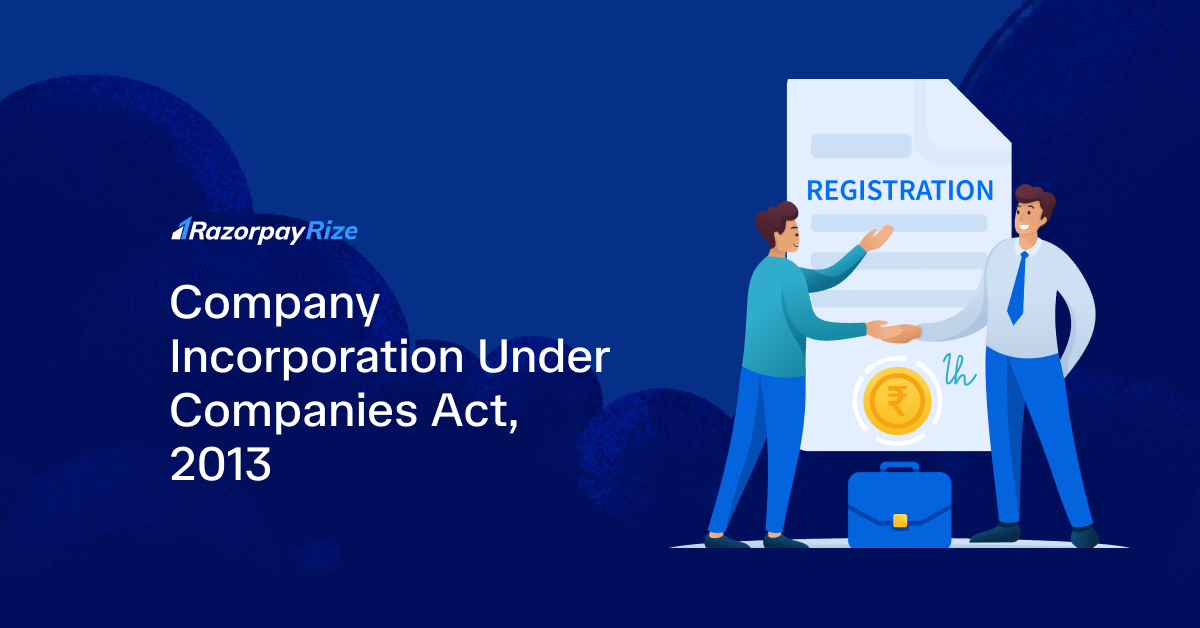
Company incorporation under the Companies Act, 2013, is the formal legal process through which a business is brought into existence as a separate legal entity in India. Once incorporated, the company becomes distinct from its founders, capable of owning assets, entering into contracts, raising funds, and being liable for its own obligations.
This guide is designed for startup founders, SMEs, professionals, and foreign founders looking to set up an Indian entity. Whether you’re building a VC-backed startup, a bootstrapped business, or an Indian subsidiary, this blog will walk you through everything you need to know- types of companies, eligibility, documents, MCA process, forms, costs, timelines, and post-incorporation compliance– in one place.
Table of Contents
Key Takeaways
- Company incorporation under the Companies Act, 2013, creates a separate legal entity with limited liability for shareholders.
- Most startups choose a Private Limited Company because it supports equity, ESOPs, and fundraising better than many alternatives.
- The core MCA flow is: DSC → DIN → Name approval → MoA/AoA → SPICe+ filing → Certificate of Incorporation.
- You need a registered office address, basic KYC of directors/shareholders, and the right MoA Object Clause aligned with your business.
- Timelines usually slip due to name rejection, incorrect attachments, or address proof issues—have backups ready.
- After incorporation, complete essentials like opening a bank account, issuing share certificates, appointing an auditor, and setting a compliance calendar.
What Is Company Incorporation Under the Companies Act, 2013?
Simple meaning of incorporation
Incorporation is the legal act of registering a company with the Ministry of Corporate Affairs (MCA) under the Companies Act, 2013. Once incorporated, the company gets its own identity- separate from its founders- recognised by law.
Legal impact of incorporation
- Creates a separate legal person
- Limits the liability of shareholders to unpaid share capital
- Enables the company to own assets and incur liabilities
- Allows the company to sue and be sued in its own name
- Ensures perpetual succession, regardless of founder exits
Incorporation vs registration vs commencement of business
- Incorporation: Birth of the company as a legal entity
- Registration: An Informal term often used interchangeably with incorporation
- Commencement of business: Post-incorporation declaration that the company has received its initial capital and can start operations
Benefits of Incorporating a Company
- Limited liability for founders and shareholders
- Credibility with customers, banks, and vendors
- Fundraising readiness for angels, VCs, and ESOP issuance
- Structured governance via board, resolutions, and statutory records
- Easier vendor onboarding with a recognised legal entity
- Clear IP ownership at the company level
- Continuity, even if founders change
Types of Companies You Can Incorporate
- Private Limited Company
A Private Limited Company is the most widely used structure for startups and growing businesses in India. It supports equity issuance, ESOPs, and external fundraising while offering limited liability and strong regulatory recognition, making it ideal for tech startups, D2C brands, and scale-ready SMEs.
- Public Limited Company
A Public Limited Company is suited for large businesses that plan to raise capital from the public. While it offers access to wider funding avenues, it comes with higher compliance and disclosure requirements and needs at least 7 shareholders and 3 directors.
- One Person Company (OPC)
An OPC is designed for solo founders who want limited liability with single ownership. It is easy to manage but has restrictions on fundraising and must convert into another structure once the prescribed turnover or capital thresholds are crossed.
- Section 8 Company (Non-profit)
A Section 8 Company is formed for charitable or social objectives. Profits cannot be distributed to members, and while tax benefits may be available, these entities face higher scrutiny to ensure activities align with their non-profit purpose.
| Type | Best for | Pros | Cons |
|---|---|---|---|
| Private Limited | Startups, SMEs | Fundraising, ESOPs, credibility | Compliance overhead |
| Public Limited | Large enterprises | Public fundraising | High regulation |
| OPC | Solo founders | Limited liability | Growth restrictions |
| Section 8 | Non-profits | Tax benefits | No profit distribution |
Documents Required for Company Incorporation
Director/shareholder KYC
- PAN (Indian nationals)
- Passport (mandatory for foreigners)
- Aadhaar / Driving License / Voter ID
- Address proof (bank statement or utility bill)
Registered office proof
- Utility bill (electricity/water/gas) not older than 2 months
- Lease deed or sale deed
- NOC from owner (if rented)
Company-level details you must decide
- Company name (2–3 options)
- Business Activity and Object Clause
- Capital structure and shareholding
- Director roles and permissions
If a director/shareholder is foreign
Foreign involvement requires additional compliance and notarisation.
- Passport apostilled or notarised
- Address proof apostilled
- FEMA considerations for shareholding
- DIN allotted via SPICe+ with passport details
Step-by-Step Process to Incorporate a Company (MCA)
Step 1: Choose company type + structure
Start by selecting the most suitable company structure- Private Limited, OPC, Public Limited, or Section 8- based on your growth plans, fundraising needs, and compliance appetite.
Step 2: Get DSC for directors
All proposed directors must obtain a Digital Signature Certificate (DSC) from a government-recognised certifying authority. The DSC is used to digitally sign MCA forms and is mandatory for incorporation filings.
Step 3: Name reservation
Apply for company name approval through SPICe+ Part A. The name must be unique, compliant with MCA naming guidelines, and clearly aligned with your business activities.
Step 4: Draft MoA and AoA
The Memorandum of Association (MoA) defines what your company does—its object clause, capital structure, and liability. The Articles of Association (AoA) lay down internal governance rules such as share transfers, board powers, and voting rights.
Step 5: File SPICe+ and linked forms
File SPICe+ Part B, the integrated incorporation form, along with linked forms like AGILE-PRO-S and INC-9. This single application covers incorporation, DIN allotment, PAN, TAN, and optional registrations such as GST, EPFO, and ESIC.
Step 6: Receive Certificate of Incorporation
Once the MCA verifies and approves the application, it issues the Certificate of Incorporation (COI). The COI includes your Corporate Identification Number (CIN) and confirms PAN and TAN allotment.
MCA Forms Explained
| Stage | Form | Purpose | Common mistake |
|---|---|---|---|
| Name | SPICe+ Part A | Name reservation | Generic or trademarked names |
| Incorporation | SPICe+ Part B | Company incorporation | Wrong object clause |
| Directors | AGILE-PRO-S | Linked registrations | Missing attachments |
| Declaration | INC-9 | Director/shareholder consent | Signature mismatch |
Cost and Timeline for Incorporation (2026)
Typical timeline
- Name approval: 1–3 working days
- Incorporation filing: 3–8 working days
- Total: 7–10 working days (From the date of document submission)
What decides the total cost
- Authorised capital
- Number of directors/shareholders
- Professional fees
- State-wise stamp duty
Post-Incorporation Checklist
- PAN/TAN confirmation
- Open a bank account
- Appoint auditor
- Issue share certificates + record shareholding
- First board meeting & basic resolutions
- Set up accounting & compliance calendar
- GST (if required) & other registrations (if needed)
Common Mistakes and How to Avoid Them
- Name rejection: Check trademarks and keep backups
- Incorrect object clause: Align MoA with real business model
- Mismatched address proof: Ensure consistency and recency
- Signature issues: Use a valid DSC and correct formats
- Poor scan quality: Upload clear, legible documents
- Wrong director details: Cross-check PAN and passport data
- Missing declarations: Verify all linked forms
- Not completing post-incorporation tasks: Plan compliance early
Razorpay Rize for Company Registration
Razorpay Rize is dedicated to fostering success through its affordable and streamlined company registration process.
Our package includes:
- Company Name Registration
- 2 Digital Signature Certificates (DSCs)
- 2 Directors’ Identification Numbers (DINs)
- Certificate of Incorporation(COI)
- MoA & AoA [Applicable for Private Limited Companies and OPCs]
- LLP Agreement [Applicable for LLPs]
- Company PAN & TAN
*Prices and documents can differ based on the company type.
Conclusion
Company incorporation under the Companies Act, 2013, follows a clear and structured flow. You begin by choosing the proper company structure, obtaining DSC and DIN, securing name approval, drafting the MoA and AoA, filing SPICe+, receiving the Certificate of Incorporation, and finally completing the post-incorporation checklist.
The key to smooth incorporation lies in clean documentation, well-defined object clauses, and early compliance planning. When these fundamentals are in place from day one, you don’t just register a company- you create a scalable, compliant, and investable foundation for long-term growth.
Frequently Asked Questions (FAQs)
Incorporation is the formal legal process by which a company comes into existence as a separate legal entity under the Companies Act, 2013. “Registration” is a commonly used informal term and, in practice, refers to the same process. Legally, once the Certificate of Incorporation is issued by the MCA, the company is considered incorporated and registered.
If documents are clean and there are no name or form rejections, incorporation typically takes 5–10 working days. Delays usually occur due to name approval issues, incorrect attachments, or problems with registered office proof.
You need KYC documents of directors and shareholders (PAN, passport for foreigners, address proof), registered office proof (recent utility bill, lease deed or ownership proof, and NOC), and company-level details such as proposed names, business activity (MoA object clause), and capital structure.
The MoA Object Clause should clearly describe your current core business while also allowing reasonable future expansion. Avoid being too narrow (which can restrict operations or fundraising) and too vague (which can lead to MCA objections).
Yes. Foreign nationals can be both directors and shareholders in an Indian company. They must provide a passport, notarised or apostilled documents, and comply with FEMA regulations. At least one director, however, must be a resident in India.
After incorporation, a company must appoint its first auditor, open a bank account, issue share certificates, conduct the first board meeting, maintain statutory registers, and set up an accounting and compliance calendar. Depending on applicability, GST and other registrations may also be required.

Swagatika Mohapatra is a storyteller & content strategist. She currently leads content and community at Razorpay Rize, a founder-first initiative that supports early-stage & growth-stage startups in India across tech, D2C, and global export categories.
Over the last 4+ years, she’s built a stronghold in content strategy, UX writing, and startup storytelling. At Rize, she’s the mind behind everything from founder playbooks and company registration explainers to deep-dive blogs on brand-building, metrics, and product-market fit.